Regenerative Agriculture
Strengthening Food Security Through Sustainable Farming Practices
DOI:
https://doi.org/10.64591/f0dsw069Keywords:
Regenerative Agriculture, Food Security, Soil HealthAbstract
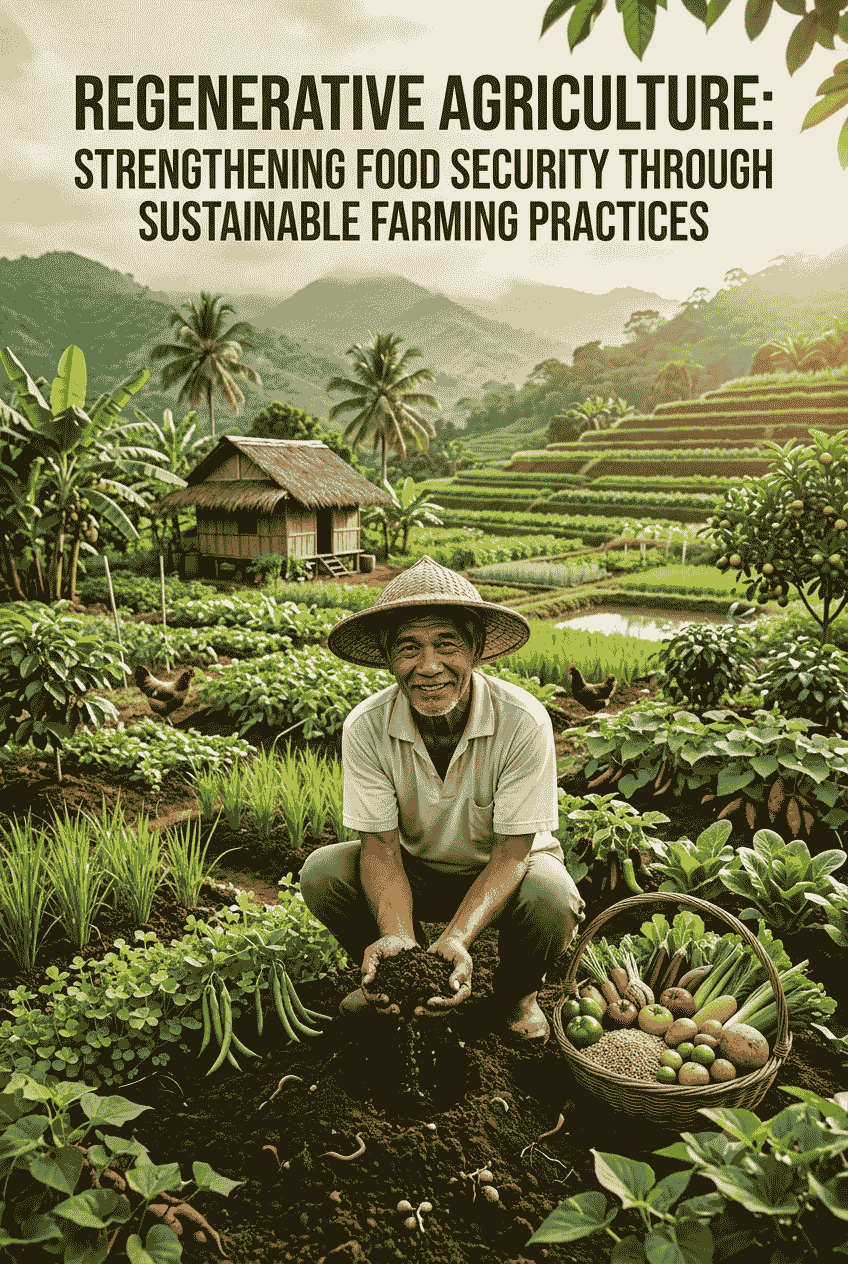
Regenerative agriculture offers a sustainable pathway to strengthen food security by restoring soil health, enhancing biodiversity, and improving resilience to climate change. Through practices such as crop rotation, reduced tillage, cover cropping, and agroforestry, it promotes productive farming while conserving natural resources. Its long-term success depends on research, farmer education, supportive policies, and locally adapted implementation.
References
Food and Agriculture Organization of the United Nations. (2022). The state of food and agriculture 2022: Leveraging automation in agriculture for transforming agrifood systems. FAO. https://doi.org/10.4060/cb9479en
Jayasinghe, S. L., Thomas, D. T., Anderson, J. P., Chen, C., & Macdonald, B. C. (2023). Global application of regenerative agriculture: A review of definitions and assessment approaches. Sustainability, 15(22), 15941.
Newton, P., Civita, N., Frankel-Goldwater, L., Bartel, K., & Johns, C. (2020). What is regenerative agriculture? A review of scholar and practitioner definitions based on processes and outcomes. Frontiers in Sustainable Food Systems, 4, 577723.
Rai, P., Godfrey, S. S., Storer, C. E., Behrendt, K., Ip, R. H., & Nordblom, T. L. (2025). Unravelling regenerative agriculture’s sustainability benefits and outcomes: A scoping review. Sustainability, 17(3), 981.
Schreefel, L., Schulte, R. P., de Boer, I. J., Schrijver, A. P., & van Zanten, H. H. (2020). Regenerative agriculture—the soil is the base. Global Food Security, 26, 100404.
Downloads
Published
Issue
Section
License
Copyright (c) 2026 SCI-TECH LENS

This work is licensed under a Creative Commons Attribution 4.0 International License.
How to Cite