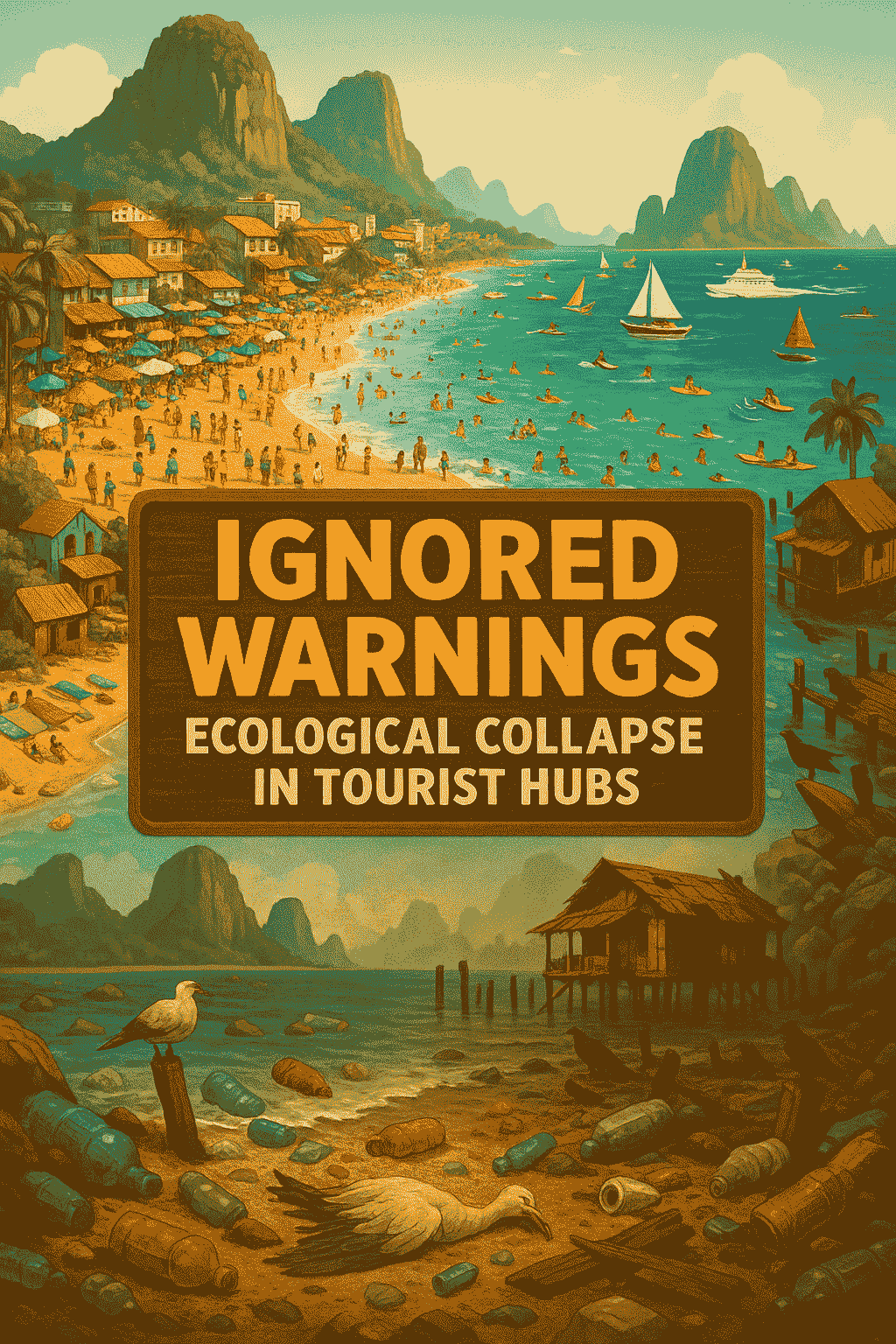
Ignored Warnings: Ecological Collapse in Tourist Hubs
DOI:
https://doi.org/10.64591/ezznq344Keywords:
Sustainable Tourism, Ecological Collapse, Environmental GovernanceAbstract
This essay highlights how unchecked tourism development in renowned Philippine destinations like Boracay and El Nido has led to water pollution, waste overflow, habitat loss, and community disruptions. Despite repeated scientific warnings, local economies prioritize short-term gains over ecological health. The paper calls for enforceable land-use plans, visitor limits, community-driven conservation, and environmental education to prevent irreversible collapse.
References
Estoque, Ronald & Murayama, Yuji. (2013). Landscape pattern and ecosystem service value changes: Implications for environmental sustainability planning for the rapidly urbanizing summer capital of the Philippines. Landscape and Urban Planning. 116. 60–72. 10.1016/j.landurbplan.2013.04.008.
Celina M. Reyes, Quimba, F. M. A., & Ortiz, M. K. P. (2018). The Boracay closure: Socioeconomic consequences and resilience management. Philippine Institute for Development Studies. Retrieved from https://pids.gov.ph/publications/5721
Cubos, Apple Shane. (2023). A Case Study of Environmental Violations in Boracay Island. SSRN Electronic Journal. 10.2139/ssrn.4656769.
Ong, L. T. J., Storey, D., & Minnery, J. (2011). Beyond the Beach: Balancing Environmental and Socio-cultural Sustainability in Boracay, the Philippines. Tourism Geographies, 13(4), 549–569. https://doi.org/10.1080/14616688.2011.590517
Parris-Piper, Naomi & Dressler, Wolfram & Satizábal, Paula & Fletcher, Rob. (2023). A virtual paradise? Platform algorithms, coastal change, and the production of nature in the Philippines. Geoforum. 138. 103669. 10.1016/j.geoforum.2022.103669.
Downloads
Published
Issue
Section
License
Copyright (c) 2025 SCI-TECH LENS

This work is licensed under a Creative Commons Attribution 4.0 International License.
How to Cite