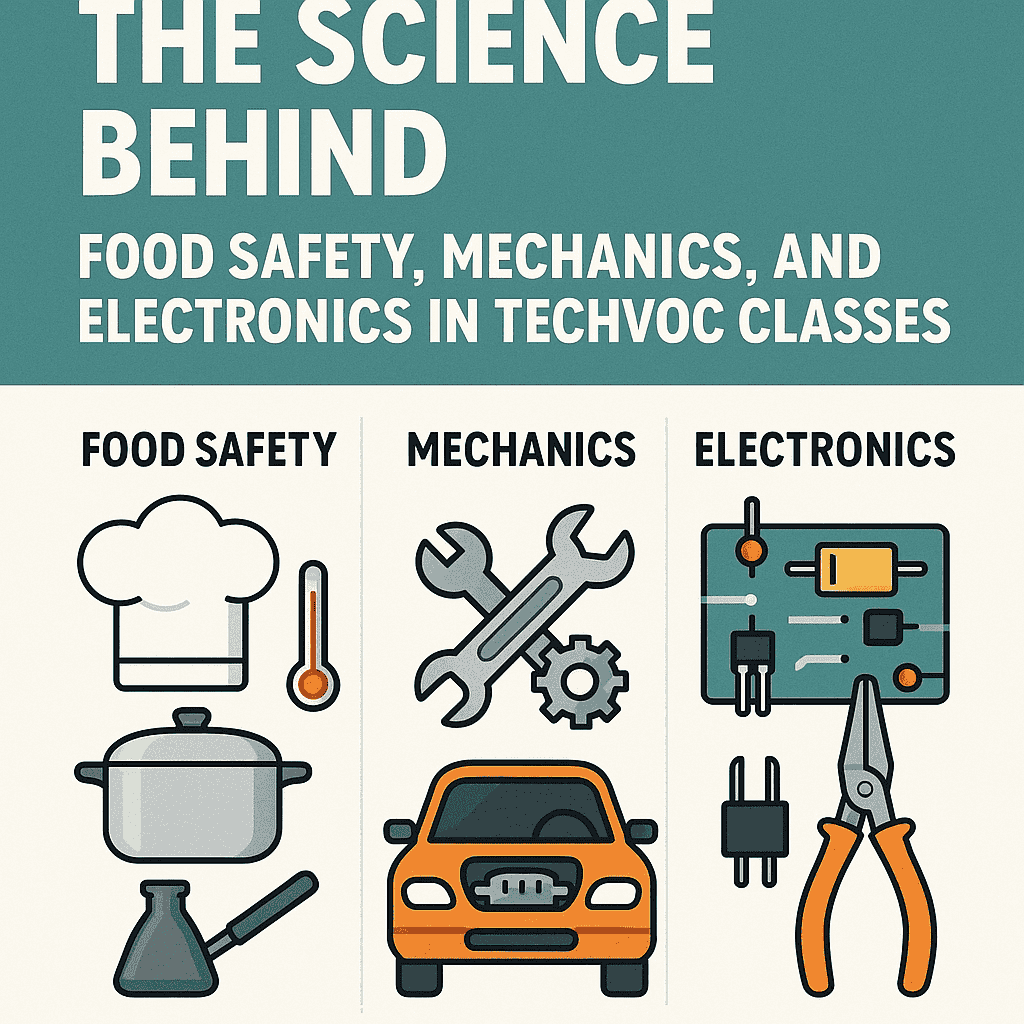
The Science Behind Food Safety, Mechanics, and Electronics in TechVoc Classes
DOI:
https://doi.org/10.64591/deq5gb48Keywords:
TechVoc education, applied science, skills developmentAbstract
This article highlights how science underpins the core skills taught in Technical-Vocational (TechVoc) education in the Philippines, particularly in mechanics, food safety, and electronics. By connecting theory to hands-on practice, students not only acquire technical expertise but also develop a deeper understanding of scientific principles, making them safer, more efficient, and more effective in their future professions.
References
Ayong, R. M. (2025). Instructional modules for constructivist environmental learning in science, technology and society (STS) subject. Journal of Environmental & Earth Sciences, 7(4), 126–137. https://doi.org/10.30564/jees.v7i4.8127
Ceneciro, C. C. (2025). Characterizing workshops promoting motivated engagement and retention beyond the sessions: Experiential narratives from education, language and social science instructors. Forum for Linguistic Studies, 7(4), 51–65. https://doi.org/10.30564/fls.v7i4.837
Dela Calzada, K. P., Tacbobo, C. M. P., Lualhati, M. E. C., et al. (2025). Alternating environmental teaching through AI: Potential benefits and limitations. Journal of Environmental & Earth Sciences, 7(4), 138–151. https://doi.org/10.30564/jees.v7i4.8340
Gibilisco, S. (2016). Physics demystified (2nd ed.). McGraw-Hill Education.
World Health Organization. (2020). Five keys to safer food manual. WHO Press.
Downloads
Published
Issue
Section
License
Copyright (c) 2025 SCI-TECH LENS

This work is licensed under a Creative Commons Attribution 4.0 International License.
How to Cite